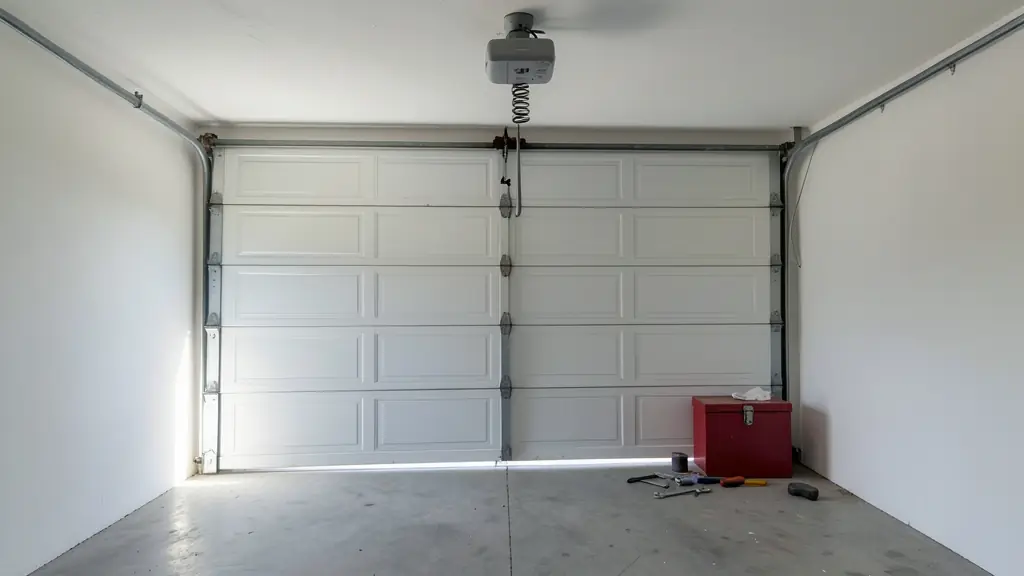
Garage door repairs are one of the most common call-outs a fitter gets, and the fault is often in the door rather than the motor. A snapped spring, a cable off its drum or a roller out of its track will stop a door just as surely as a dead control board. This page goes through the faults people see most, what usually causes them, what you can safely do while you wait for a fitter, and how repair quotes are put together.
Door faults
- Broken spring: often a loud bang from the garage, then a door that is suddenly very heavy or opens only a little way.
- Cable off the drum: the door hangs crooked, one side higher than the other.
- Door off its track: rollers have jumped out, usually after the door was hit or a track worked loose.
- Worn rollers and hinges: grinding, squealing and a door that judders (see rollers and hardware).
- Bent panels: often from a car bumper; a panel can sometimes be replaced on its own.
Motor faults
In general terms, the symptoms point the fitter in a direction:
- Hums but doesn't move: often a door that is too heavy (a broken spring), a jammed door, or worn gears inside the motor.
- Clicks: the board is trying to start the motor; it can be the battery, the power supply or the board.
- Blinks: many motors flash a light to report a fault, such as blocked beams or a low battery. The maker's manual explains the pattern.
- Runs but the door doesn't move: the trolley may be disengaged, or a chain, belt or gear has failed.
A board that died after a storm is a common spares job.
What to do while you wait
Stop using the motor if the door is crooked or heavy. Don't touch the springs, cables or bottom brackets: they are under high tension and can cause serious injury, and spring work is never DIY. If a spring has broken, don't pull the manual release with the door open, because the door can drop. Keep children and pets clear, and if the door won't lock, park a car across it.
How repairs are quoted
Most repairs carry a call-out fee to find the fault, then parts and labour. After-hours and weekend call-outs usually cost more. Describe the symptoms and send a photo when you ask, so the fitter can bring the likely parts. A spring job is normally quoted per spring, with cables and a balance adjustment included or listed. If several things are worn, ask the fitter to separate what must be fixed now from what can wait for the next service.
What to put in your request
- What the door or motor is doing
- A photo of the door and the springs
- Door type and width
- Whether the door is stuck open or closed
- Whether you need an after-hours call-out
Garage Door Repairs for homes, complexes, estates, shops, warehouses, farms and more
- Houses: a snapped spring or a motor that stopped after a storm on a family garage
- Townhouse complexes and body corporates: doors on townhouse units repaired on one call-out for the body corporate
- Security estates: repairs to double sectional doors, done to the estate's access rules
- Offices and business parks: a basement or parking door stuck open or closed at an office block
- Shops, restaurants and filling stations: a shop roller door that sticks halfway or won't lock at closing time
- Factories, warehouses and workshops: workshop and warehouse doors back in service with minimal downtime
- Farms, smallholdings and lodges: a shed or farmhouse garage door fixed by a fitter from the nearest town
- Schools, clinics and public buildings: doors at schools, clinics and council depots repaired and made safe
- Builders and developers: snag repairs to doors and motors on new units before handover