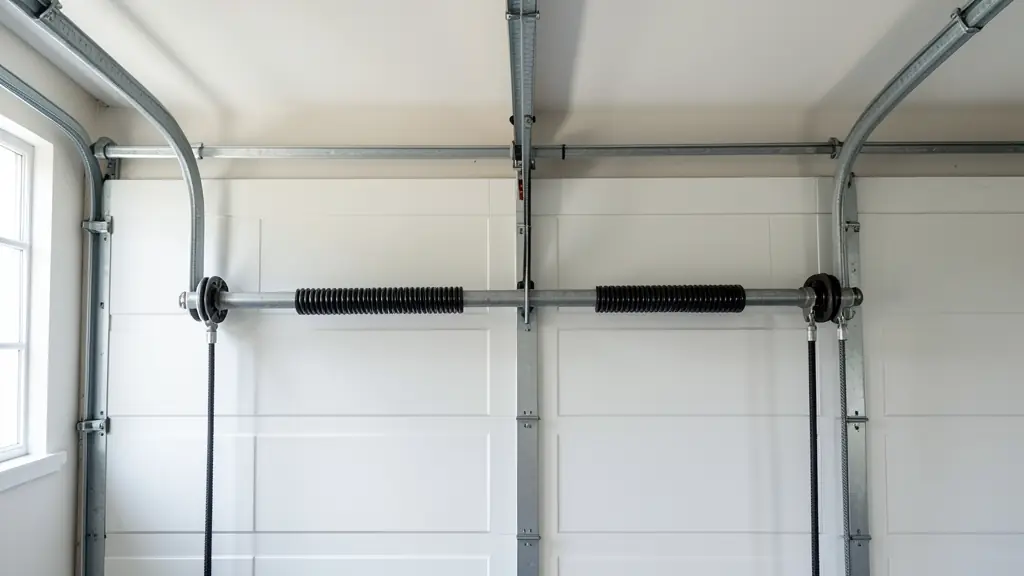
Garage door springs carry the weight of the door. The motor, or your arms, only move a door the springs have already balanced. When a spring snaps, often with a loud bang from the garage, the door suddenly feels far too heavy and the motor strains or stops. Broken springs are one of the most common call-outs fitters get. This page explains torsion and tension springs, how they wear, why they are replaced in pairs, and why spring work is a job for a trained fitter, never a weekend project.
Torsion and tension springs
Torsion springs sit on a steel shaft above the door. They wind up as the door closes and turn the shaft as it opens, lifting the door by cables wrapped around drums at each end. They are common on sectional doors. Tension springs stretch along the side tracks or frames and pull the door up; you see them on many sectional and older tilt doors. Roll-up doors keep their spring inside the drum. Each spring is sized to the door's weight and height, so it is ordered for your door, not picked off a shelf. See sectional and tilt-up door motors for how motors suit each door.
Why springs are dangerous
A wound or stretched spring stores a lot of energy. When it lets go, or when someone loosens the wrong fitting, a bar, a bracket or the spring itself can strike hard enough to cause serious injury. That is why spring work is for a trained fitter with the right winding bars and tools. Do not adjust, unwind or replace springs yourself, and don't pull on the cables. If a spring has broken, leave the door closed if you can, switch off the motor so nobody tries to run it, and keep children and pets out of the garage until the fitter arrives.
Signs of wear
- A gap between the coils of a torsion spring, which usually means it has broken.
- The door feels heavy, won't stay put when lifted halfway by hand, or drops fast.
- The door rises unevenly, or a cable hangs loose or has come off its drum.
- Rust along the coils, especially near the coast.
- The motor strains, slows or reverses on the way up.
Why both springs are replaced together
Springs are rated for a number of cycles, and both springs on a door have done the same number. When one breaks, the other is usually close behind, so most fitters replace them as a pair and you pay one call-out instead of two. A good spring job also checks the cables, drums, bearings and shaft, then sets the balance so the door stays put halfway. Ask for both springs and the balance check on the quote. If the motor has been straining, have it checked too: see garage door repairs.
What to put in your request
- Door type: sectional, tilt or roll-up
- Door width and height
- Torsion or tension springs, with a photo
- Whether one or both springs have broken
- Whether the motor has been straining
Garage Door Springs for homes, complexes, estates, shops, warehouses, farms and more
- Houses: a pair of torsion springs on a double sectional door, or tension springs on an older tilt door
- Townhouse complexes and body corporates: springs on many small doors, worth replacing on a schedule rather than one call-out at a time
- Security estates: springs on heavy double doors, sometimes with higher-cycle springs for busy households
- Offices and business parks: springs on basement and parking doors that open many times a day
- Shops, restaurants and filling stations: springs inside the drums of shopfront roller shutters, checked when the shutter gets heavy
- Factories, warehouses and workshops: heavy torsion springs on big sectional doors, replaced by fitters with the right equipment
- Farms, smallholdings and lodges: springs on shed and garage doors that rust in damp or dusty conditions
- Schools, clinics and public buildings: springs on doors at schools, clinics and municipal depots, checked on every service
- Builders and developers: springs matched to each new door's weight and balanced before the motor goes on