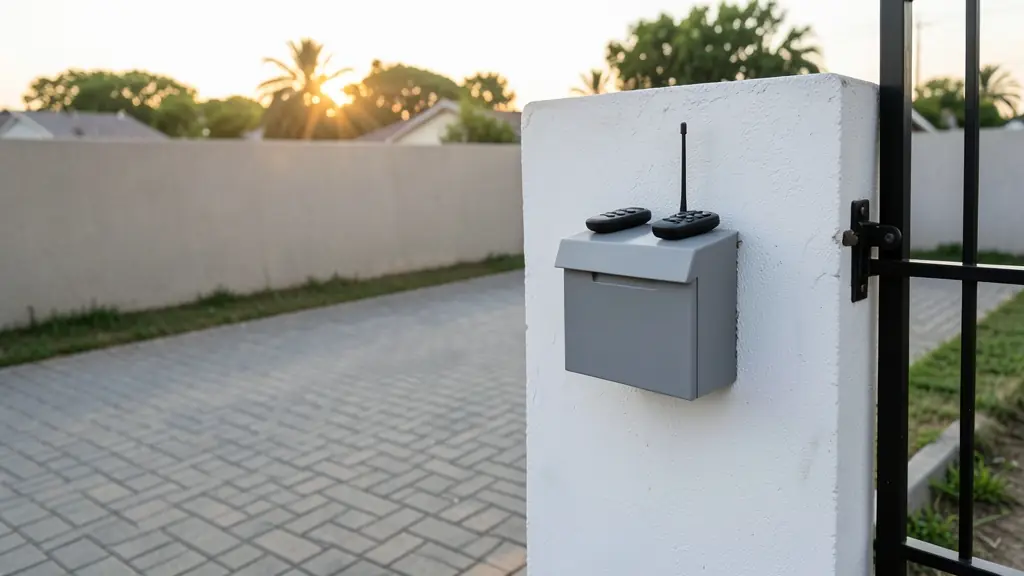
If you have searched garage door remote how to program, the short answer is that every remote has to be learned to the receiver in the motor, or to a separate receiver, before it works. The exact button sequence differs between motors and is in the maker's manual. This page explains how learning works in general, why lost remotes should be deleted, and the other ways to open a gate or door, from keypads to phone openers, with notes for complexes and estates.
How remotes are learned
Most gate and garage motors in South Africa use 433 MHz remotes, but the code system matters as much as the frequency: a remote only works with a receiver that understands its code. Learning usually means putting the receiver into a learn mode, often with a button on the board, and then pressing the remote button you want to use. Many remotes are code hopping, which changes the signal every time and is much harder to copy. If the manual's steps don't work, the remote may simply not be compatible.
Lost or stolen remotes
A lost remote can still open your gate. Delete it from the receiver's memory. Some receivers can delete one remote; others can only be cleared completely, after which every remaining remote has to be learned again. Landlords should do this between tenants, and complexes when residents move out. If a remote was stolen with your keys or your car, treat it as urgent and clear it the same day. Keep a note of how many remotes are learned to each receiver, so you know when one is missing. On a motor with a manual release on the outside, think about who else could reach it and keep it secure.
More ways in
- Extra receivers let one remote open the gate and the garage, or let new remotes work with an older motor.
- Longer-range antennas help where remotes only work close to the gate.
- Keypads on the pillar for a code instead of a remote.
- Intercoms so visitors can call the house and be let in.
- GSM and Wi-Fi openers for phone control, covered on the smart opener page.
Complexes and estates
A shared gate may have dozens or hundreds of users. A receiver with a large memory, or a system that logs which remote is used, makes it easier to add new residents and delete departing ones. Ask whether the body corporate or estate keeps a register, and who is allowed to add remotes. Many complexes make one trustee or the managing agent responsible, so remotes are never handed out without being recorded. Where remote cloning has been a problem, moving the whole complex to code hopping remotes and a matching receiver is a common fix, done in one planned visit with residents bringing their remotes in.
What to put in your request
- Which motor and receiver you have
- How many remotes you need
- Whether any remotes were lost or stolen
- How many people use the gate or door
- Whether you want a keypad, intercom or phone
Remote Programming and Access Control for homes, complexes, estates, shops, warehouses, farms and more
- Houses: new remotes learned to the gate and garage, and a lost one deleted
- Townhouse complexes and body corporates: remotes added and removed as residents move in and out
- Security estates: a large-memory receiver and register for hundreds of users
- Offices and business parks: staff remotes, keypads and intercoms on a parking gate
- Shops, restaurants and filling stations: remotes for staff on a delivery yard gate and roller door
- Factories, warehouses and workshops: keypads and remotes for shifts on a factory gate
- Farms, smallholdings and lodges: remotes and a longer-range antenna for a gate far from the house
- Schools, clinics and public buildings: controlled access at school, clinic and municipal gates
- Builders and developers: receivers, remotes and keypads set up for a new complex