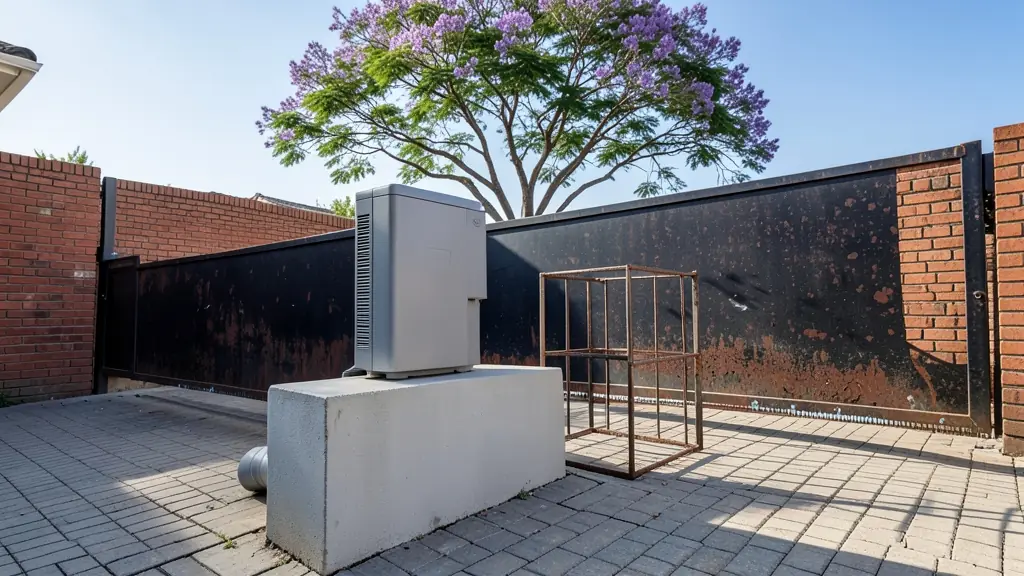
Gate motor installation is mostly about the gate. A sliding gate that drags on a bent track or rocks on worn wheels will burn through a motor and battery, however good they are. A proper installer checks the gate first, then casts a level plinth, bolts the rack along the gate, brings power to the motor and sets it up. With a new plinth and rack, the job often takes most of a day. This page covers each step for sliding and swing gates and what an installation quote should list.
Fix the gate first
Push the gate open and closed by hand. It should run with an even, light push and stay where you leave it. Before fitting a motor, an installer looks at:
- Wheels and track: worn wheels and a bent or loose track make the gate heavy.
- Guide rollers at the top that keep the gate upright without binding.
- End stops at both ends so the gate can't run off its track.
- Anti-lift measures so the gate can't be lifted out.
On swing gates the hinges must be sound and the leaves must not sag.
Plinth, rack and power
A sliding gate motor sits on a concrete plinth beside the gate, level and at the right height so the pinion meshes with the rack. The rack is bolted or welded along the gate with a small, even gap above the pinion along its whole length. The motor needs mains power to charge its battery: usually a cable in conduit from the house, sometimes in a trench across the garden or driveway. That supply, and any surge arrestor, is work for a registered electrician. Where power is far away, a bigger battery and a solar panel are an option.
Swing gates
A swing gate takes an arm on each leaf, fixed to the pillar and the gate, with a control box and battery nearby. The installer checks the pillars are solid enough to take the brackets, that there is room to open on the property side, and how wind will load a solid leaf. On a sloping driveway a swing gate may not clear the ground when it opens, which can rule out swing arms altogether or call for the gate to be rehung. Long or heavy leaves need arms rated for them, and a double gate needs both arms set so the leaves meet and lock together.
Finishing the job
Once the motor runs, the installer sets the travel limits and obstruction sensing, learns the remotes, and fits safety beams across the opening. An anti-theft bracket over the motor is worth asking for where motors and batteries are stolen. Earthing and surge protection help the control board survive summer lightning.
What to put in your request
- Sliding or swing gate, and its width
- What the gate is made of and roughly how tall
- Whether it runs easily by hand
- Distance from the gate to a power point
- Extras: beams, theft bracket, solar, keypad
Gate Motor Installation for homes, complexes, estates, shops, warehouses, farms and more
- Houses: a sliding gate motor on a new plinth with a rack and two remotes
- Townhouse complexes and body corporates: a heavy-duty motor on a shared gate that opens many times a day
- Security estates: motors on estate and home gates fitted to the estate's rules
- Offices and business parks: a sliding gate motor on a business park or office parking entrance
- Shops, restaurants and filling stations: motors on delivery yard gates behind shops and filling stations
- Factories, warehouses and workshops: heavy-duty motors on steel gates at factories and warehouse yards
- Farms, smallholdings and lodges: a solar-powered motor on a long gate far from the farmhouse
- Schools, clinics and public buildings: motors on gates at schools, clinics and municipal yards
- Builders and developers: gate motors, plinths and power planned into new homes and complexes