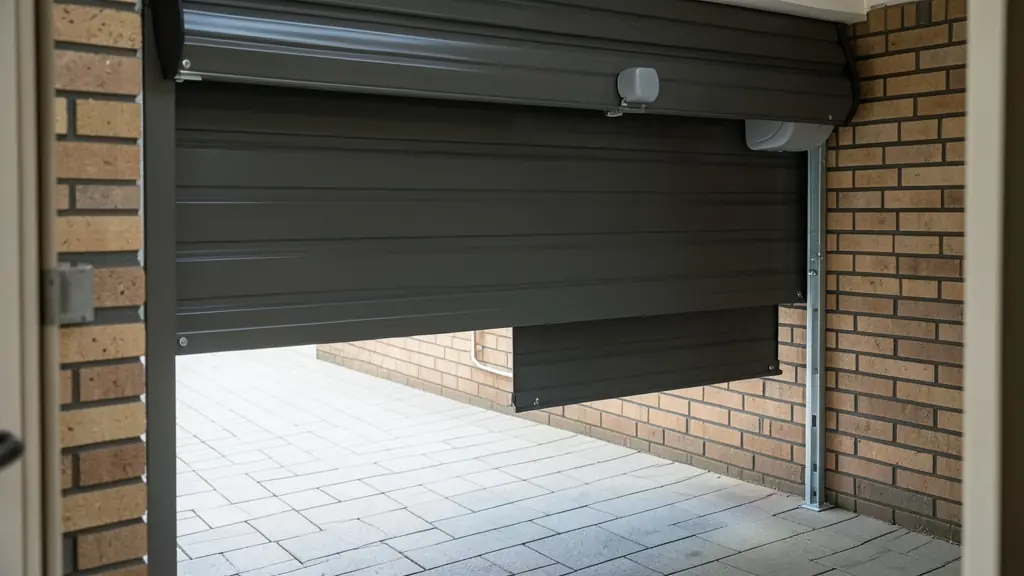
A roll-up door, also called a roller door, coils onto a drum above the opening, so a roll up garage door motor works differently from a ceiling opener. It mounts on the side of the drum or inside the shaft and turns the drum itself. There is no rail and no trolley, which suits garages with low ceilings, lofts or storage racks overhead. Townhouse garages, shopfronts and outbuildings use them widely. This page covers how the motor fits, the manual override, balance in the drum and what to ask for.
How a drum motor fits
On many home roll-up doors the motor replaces one of the drum's end brackets and drives the drum directly; on others it sits inside the shaft. Either way it needs a plug point near the top of the door, and an electrician fits one if there is none. The fitter sets the travel limits so the door stops neatly at the top and at the floor. Because nothing hangs from the ceiling, the space above stays free. The drum brackets and the wall they are bolted to carry the door and the motor, so the fitter checks they are solid. If the brickwork above a townhouse door is cracked or the brackets are loose, that is fixed first. On a double width door the motor has more weight to turn, so check its rating against the door.
Springs and balance in the drum
Roll-up doors carry their weight on springs wound inside the drum. If the door is heavy to lift by hand or runs down on its own, the springs need tensioning or replacing before a motor goes on, otherwise the motor strains and wears. Drum springs are under tension and dangerous to adjust, so leave them to a trained fitter. Worn side guides and bent slats also make a door stick halfway, and those go on the quote too. See garage door repairs.
Slatted, corrugated and shopfront doors
- Corrugated sheet doors: one rolled sheet, common on homes and townhouses, light and simple.
- Slatted doors: interlocking steel or aluminium slats, stronger and often used on shops and workshops.
- Shopfront roller shutters: opened every morning and closed every evening, so they need a motor rated for that use. Big warehouse shutters move into industrial door motors.
Manual override and security
Every drum motor needs a way to open the door when the power and battery are both out: a release on the motor or a hand crank, depending on the model. Ask where it is and how it is secured, because an exposed release is a weak point. Roll-up doors can also take a lock or lock bar. A battery backup keeps a home door working through load shedding; check which motors on the quote include one. Infrared safety beams stop the door coming down on a car bonnet.
What to put in your request
- Width and height of the opening
- Corrugated sheet or slatted door
- Home, townhouse or shopfront, and daily use
- Whether there is a plug point near the drum
- Whether the door is heavy or sticks by hand
Roll-Up Garage Door Motors for homes, complexes, estates, shops, warehouses, farms and more
- Houses: a drum motor on a single or double corrugated roll-up door
- Townhouse complexes and body corporates: drum motors on rows of townhouse roll-up doors, one remote per unit
- Security estates: roll-up door motors on golf cart garages, stores and outbuildings
- Offices and business parks: motors on roll-up doors to storerooms and basement parking
- Shops, restaurants and filling stations: motors on shopfront roller shutters opened and closed every day
- Factories, warehouses and workshops: drum motors on smaller workshop and storeroom roller doors
- Farms, smallholdings and lodges: motors on roll-up doors to sheds, stores and workshops
- Schools, clinics and public buildings: roll-up door motors on clinic stores, depots and school halls
- Builders and developers: drum motors supplied with new roll-up doors on townhouse units
Frequently asked questions
Do you install roll-up door motors yourselves?
No. We are a free quote request service. Independent installers and door companies in your area receive your request and quote you directly. Tell them the door width and height, whether it is corrugated or slatted, and how often it opens.
Can I fit a motor to my existing roll-up door?
Usually, if the door rolls freely and the drum springs are in good order. The installer checks the drum, guides and slats first and tells you if anything must be fixed before the motor goes on. A door that has been dented by a car or has slats pulled out of the guides usually needs repairs on the same visit.
My roll-up door motor runs but the door does not move. What is wrong?
The manual release may be engaged, or a part between the motor and the drum has worn or slipped. Don't force it. Book a repair call-out; some parts are available from spares suppliers.
Is a roll-up door motor quieter than a ceiling motor?
It depends more on the door than the motor. Corrugated sheet doors rattle in their guides as they roll; a well-lubricated slatted door is smoother. Ask the installer to check the guides when they fit the motor.