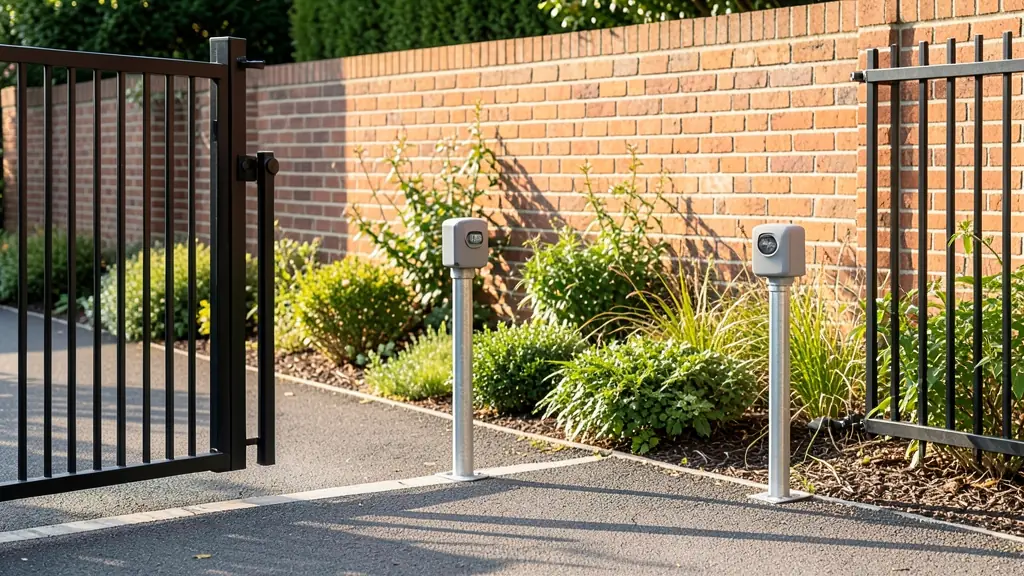
A garage door sensor or a pair of safety beams is the part that stops a closing door or gate before it hits a car, a pet or a child. Infrared beams send an invisible line across the opening; when something breaks it, the motor stops or reverses. Together with the motor's own obstruction sensing, they are the main safety system on any automated door or gate. Here is how beams are fitted, why they misbehave, and what to ask for on a home gate, a complex gate or an industrial door.
How safety beams work
A beam set is a pair: a transmitter on one side of the opening and a receiver on the other, or a single unit with a reflector. While the receiver sees the infrared beam, the motor runs normally. If the beam is broken while the door or gate is closing, the motor stops and usually opens again. Wired beams run cables back to the motor's board and are the most reliable; wireless beams have a battery in the transmitter and suit gates where a cable is hard to run. That battery must be changed in time, or the gate may refuse to close.
Height and double beams
On a sliding gate, beams usually go on posts or the walls just inside the gate line, at a height that catches a car's body. A single beam at that height can miss a low pet or a small child, so many installers fit a second pair lower down. Garage door beams are usually mounted low on each side of the opening, just inside the door. The installer chooses the heights to suit your gate, your cars and your household. See sliding gate motors and gate motor installation.
Why beams cause trouble
- Alignment: a knock, a loose post or shifting ground moves one side and the gate won't close.
- Sunlight: low morning or afternoon sun shining straight into a receiver can blind it.
- Dirt, spiders and plants: dust on the lens, webs and overgrown shrubs break the beam.
- Damp and ants: in the housing or a cable joint, causing faults that come and go.
- Damaged cables: cut by a garden trimmer or chewed.
Wipe the lenses and trim the plants first; if the motor still shows a beam fault, call a fitter.
Obstruction sensing and safety edges
Every motor should also stop and reverse when it meets resistance. Test it on a garage door by putting a closed cardboard box in the doorway and closing the door: it should reverse on contact. Large industrial doors often add a safety edge, a rubber strip along the bottom of the door that stops it on contact. Both should be tested on every service. Never disable beams to stop false alarms; have them fixed.
What to put in your request
- Gate or door type and the opening width
- Wired or wireless, and whether a cable can run
- Whether you have pets or small children
- Any beam fault the motor shows now
- Posts or wall mounting, and the surface
Safety Beams and Sensors for homes, complexes, estates, shops, warehouses, farms and more
- Houses: a pair of beams on the sliding gate and another low across the garage door
- Townhouse complexes and body corporates: beams on the entrance and exit gates where many cars and children pass every day
- Security estates: double beams on entrance gates and booms, tested as part of the estate's service contract
- Offices and business parks: beams on parking gates and basement doors where cars queue close to the gate
- Shops, restaurants and filling stations: beams on delivery gates and safety edges on big shutters at loading doors
- Factories, warehouses and workshops: beams and safety edges on heavy doors and gates where trucks and forklifts move
- Farms, smallholdings and lodges: beams on yard gates where dogs and livestock might be caught by a closing gate
- Schools, clinics and public buildings: double beams on school and clinic gates where children and patients walk through
- Builders and developers: beams fitted and tested on every new gate and garage door before handover