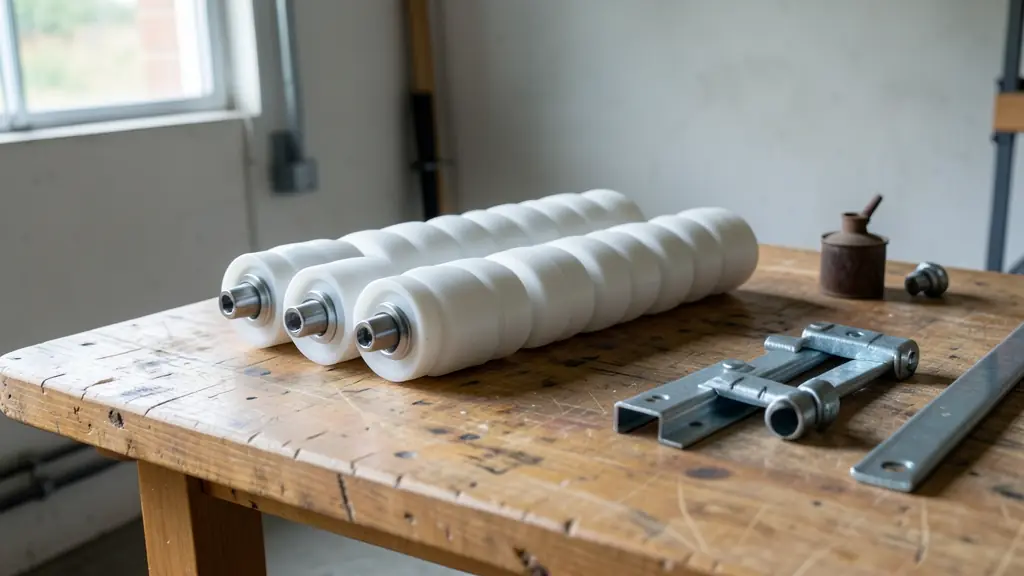
Garage door rollers are the small wheels that carry each door panel up its tracks. When they wear, the door gets noisy, jerky and harder to lift, and the motor works harder every time it opens. Rollers, hinges, tracks and brackets cost little compared with a motor, and replacing worn ones is often the fix for a door that grinds or shudders. Here is what to look for, how nylon and steel rollers differ, and what a fitter checks on the rest of the hardware while they are there.
Nylon and steel rollers
A roller is a wheel on a steel stem that slides into a hinge or bracket on the door. Steel rollers are strong and cheap but noisy, and they rust in salt air. Nylon rollers run quieter and suit homes where the garage sits under a bedroom; the better ones have sealed ball bearings inside, which last longer and turn more freely than a plain wheel. Rollers come in a few common wheel sizes and stem lengths, so measure an old one or take it along. Fitters usually replace them as a full set: one per hinge, plus the top and bottom brackets.
Hinges, tracks, cables and brackets
The rollers are only part of the hardware. Hinges join the panels of a sectional door and crack, or wear their holes oval, over time. Tracks must be straight, parallel and firmly fixed; a car bumping one bends it and the door binds. Cables run from the bottom brackets to the spring drums and fray before they snap. The bottom brackets hold those cables under tension, so, like the springs, they are for a trained fitter to touch.
Noisy door? Work through it in order
- Squeaks: dry rollers, hinges or bearings; a light lubricant on the moving parts often helps.
- Grinding: worn roller bearings or a wheel worn flat on one side.
- Banging or shuddering: loose track fixings, a bent track or a cracked hinge.
- Rattling from above: a slack chain or loose rail on the motor; see motor spares.
Don't grease the tracks heavily: dirt sticks to it and the rollers skid instead of turning.
When to replace rather than oil
Replace rollers when the wheels are cracked, wobble on the stem, have flat spots or have bearings that no longer spin freely. Near the coast, rusted steel rollers usually go straight to nylon. A door that runs freely by hand puts less strain on the motor and its gearbox, so the hardware is worth keeping right. A roller job is also a good time for a full service: balance check, spring and cable inspection, track alignment, tightening every fixing and testing the motor's obstruction sensing.
What to put in your request
- Door type, width and number of panels
- Nylon or steel rollers, and how many
- Any cracked hinges, bent tracks or frayed cables
- How noisy or heavy the door is by hand
- Whether you want a service at the same time
Garage Door Rollers and Hardware for homes, complexes, estates, shops, warehouses, farms and more
- Houses: a set of quiet nylon rollers on a double sectional door that has started to grind
- Townhouse complexes and body corporates: roller sets for a row of townhouse doors, often done on the same day as a service
- Security estates: nylon rollers and new hinges where estate homes want a quieter door under a bedroom
- Offices and business parks: rollers, hinges and tracks on basement doors that run many times a day
- Shops, restaurants and filling stations: guides and bearings on shopfront roller shutters that stick or grind
- Factories, warehouses and workshops: heavy-duty rollers and track repairs on big sectional doors bumped by forklifts
- Farms, smallholdings and lodges: rollers and hinges on shed and garage doors worn by dust and damp
- Schools, clinics and public buildings: roller and hinge replacement on depot and school doors during a yearly service
- Builders and developers: checking rollers, tracks and fixings on new doors before handover